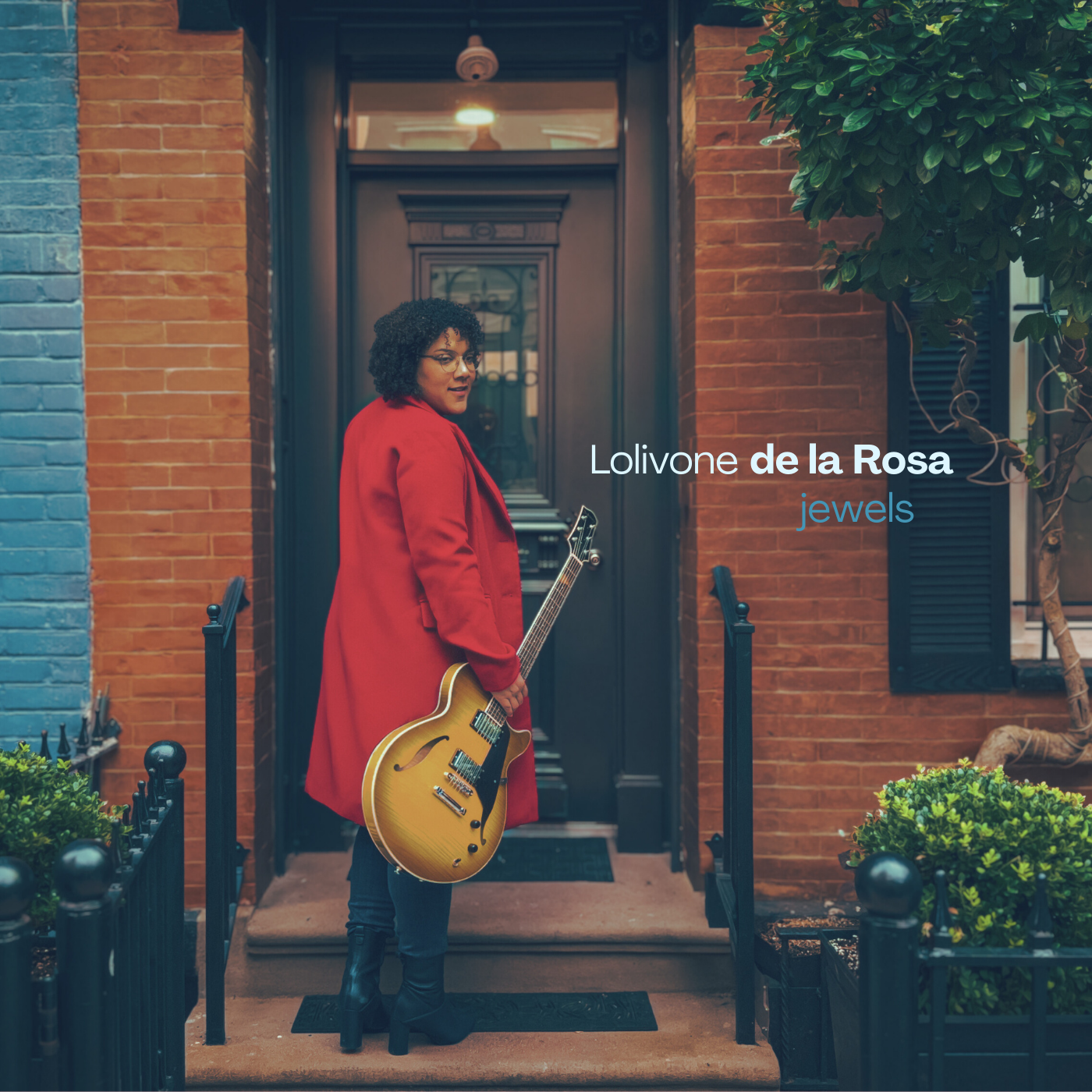

JEWELS OUT NOW
Subscribe to receive
IBERO session video
REQUEST PRESS ASSETS at LYDIA LIEBMAN PROMOTIONS

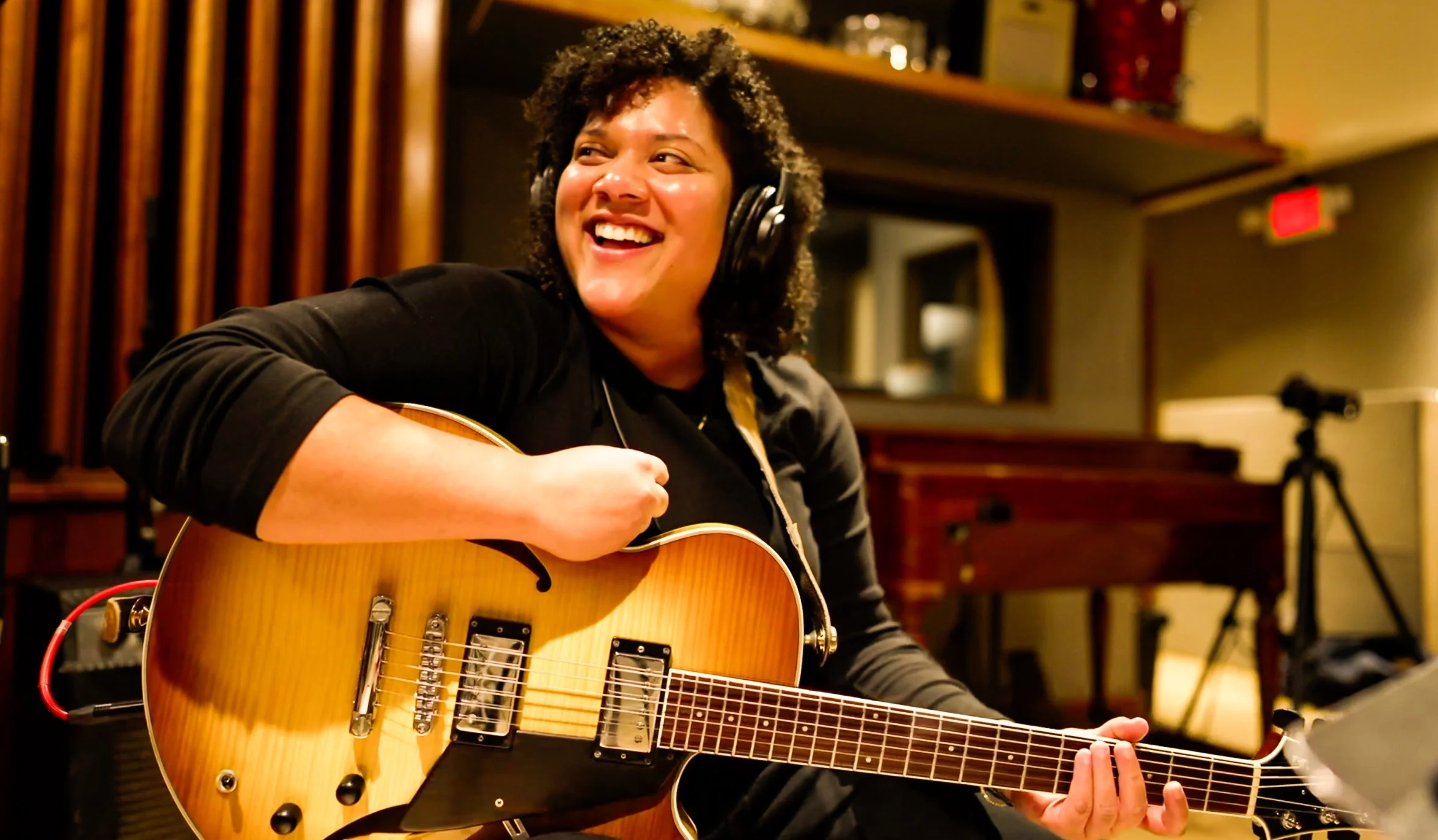
Booklet Notes for Jewels, by Lolivone de la Rosa:
This album is a deeply personal debut that weaves Puerto Rican memory, bebop lineage, and storytelling into a musical journey shaped by love, nostalgia and community. Original compositions sit alongside reimagined standards and folkloric tributes, moving between straight-a-head, afro-rican and afro-cuban rhythms and introspective songcraft while honoring mentors, collaborators, and family. Each track carries a lived story—from childhood radios and neighborhood heroes to pandemic solitude and humor in adversity. Together, the record feels like a homecoming and a first voyage at once: rooted, adventurous, playful, and sincere. - Lolivone de la Rosa
***************
In the avuncular, informative text that Lolivone de la Rosa wrote to accompany her excellent debut album, the 33-year-old guitarist-composer mentions that the album-ending title track, her first-ever composition, is a dedication to the gems in her life: her parents and her brother. Her father, a skilled, experienced jeweler who in his youth played the trumpet, bought her a guitar when she turned 13 years old. As she learned the instrument during formative years in Trujillo Alto, a San Juan-adjacent municipality, she modeled his discipline, which was matched by her mother, a singer in Puerto Rico’s first all-woman Bomba band, who decided to pursue a career in psychology upon reaching her forties.
“I’m a perfectionist,” de la Rosa says. She references a moment during the post-production mix with first-call engineer Dave Darlington. “We talked about how meticulous I was getting. I thought we’d mix it in one session. It took us five weeks. He was very patient. I would go back and say, ‘Dave, don’t kill me, but let’s lower one DB on that note,’ or the trumpet or guitar is too loud on a particular part. He said, ‘That’s why the album is called Jewels, because we’re polishing them.’”
The fruits of de la Rosa’s disciplined search for beauty and meaning in notes and tones are apparent throughout the bilingual program, which opens with her swing-to-clave arrangement of “Si Por Mi Llueve” that includes a “Perdido” contrafact in the solo form. It was a 1971 hit for Cheo Feliciano, her neighbor in Trujillo Alto, who “embodied the charisma and sense of community that defines what it means to be Puerto Rican.” She continues: “This record is like the first baby. People want to know, ‘Who is she?’ ‘Where does she come from?’ So I did this arrangement, just to give a sense of where I’m coming from. I want to explore points of convergence between where I’m from and where things could move forward, taking what I know and challenging myself to get out of it.”
She undertakes her explorations with an unfailingly plush, centered tone and keen attention to note selection and dynamics, whether joining the flow within her world-class rhythm section – drummer Jeff Watts, pianist Luis Perdomo, and bassist John Benítez – or drawing inspiration from them as she spins out expansively imaginative, thematically cogent improvisations in dialog with veteran masters Ingrid Jensen on trumpet and Ned Goold on tenor saxophone. In short, she functions as “one of the cats,” imprints her tonal personality on spirited investigations of bomba, bolero, blues, Great American Songbook, and bebop (a la Bird and Monk) lineage, imbued with the esprit de corps that transpires when the band is having serious fun.
If de la Rosa’s elite musical and people skills played a large role in sustaining that relaxed ambiance, so were the ministrations of her mother, whose home-cooked pastelón (also known as Puerto Rican lasagna for its layered admixture of sweet plantains, picadillo, and cheese) and onion rice fueled the fire as the band generated the 13 tracks on the Friday and Saturday after Thanksgiving. “It was a beautiful session, kind of like a family occasion,” she says. “My feedback was that everyone felt taken care of.”
“When I was little, my mom took me to her gigs, because I couldn’t stay home alone,” de la Rosa recalls. She began piano at 9, but grew bored with reading music and stopped. She started playing guitar in her middle-school’s after-hours program, and spent the next few years developing her facility, focusing primarily on Puerto Rican folkloric music under the instruction of Elba Lugo.
Primarily interested in Puerto Rican folkloric music during her early guitar studies, de la Rosa was 16 when she began private lessons with Fernando Mattina, “who every guitarist in Puerto Rico who wants to play jazz studies with,” and attended a week-long Berklee in Puerto Rico program. “I was placed in an ensemble where everyone except me could improvise, and I wanted to learn how to do it,” she says. “I couldn’t go to Berklee without a scholarship.” For the next six years, de la Rosa studied with Mattina, attended the Berklee program and auditioned each year. Meanwhile, she studied environmental engineering and finished her degree in 2017, the year that Berklee finally awarded her a full scholarship.”
Although Mattina had given de la Rosa “a list of guitarists to check out,” she was focusing mostly on folkloric practitioners like cuatro player Yomo Toro, and saxophonists Paquito D’Rivera and Joe Lovano. Soon after she arrived in Boston, she transcribed Kurt Rosenwinkel’s solo on Charlie Parker’s “Segment” from the 2004 Criss Cross album Intuit on assignment from guitar teacher Freddie Bryant. “I didn’t think I’d be able to do it,” she says. “It was a challenge to understand what Kurt was trying to say through his solo and how to best put my fingers on the fretboard in a way I hadn’t done before. But I was grateful for the challenge.”
On Jewels, she demonstrates how thoroughly she fulfilled the “Segment” assignment, uncorking a discursively propulsive solo on which she interacts comfortably with Watts’ open, laid-back beats, then gives way to Perdomo for a Monkishly clave-centric solo, which resolves to an open-ended Benítez-Perdomo-Watts tumbao triologue, before everyone returns to the melody.
She references another “aha” moment from Berklee years on the “minor swinger” “PB&J,” a contrafact based on guitarist Peter Bernstein’s “Bones.” “Peter was on Fernando’s list, but I didn’t check him out until I took a lab class with Bruce Saunders on his music,” de la Rosa says. “I had made myself a rule that I wanted a good tone and I didn’t want to get into pedals. His sound is so pure. He’s just connected to an amp.”
De La Rosa contacted Bernstein for lessons, and began making short trips to New York that made her “feel attracted to the idea of coming here because of the community that I encountered.” The onset of Covid-19 precipitated a retreat to Puerto Rico, where she completed her Berklee courseload online. She moved to New York in June 2021, and set about embedding herself on the scene with characteristic discipline and preparation. Before the move, she’d cold-called a Lower East Side restaurant, Casa Mezcal, about hosting a weekly residency, and used it as a creative laboratory, inviting musicians like vocalist Vanisha Gould, organist Brian Charette, and Benítez.
She also started frequenting Smalls, where she met Ned Goold, who hired her for his band and pushed her to develop fluency in the blues and dominant chords that are at the core of his harmonic system, helping her to find her voice. She continues to play his music two nights a month at Brooklyn’s Ornithology club, often performing “Tote Bag,” a space funk-to-swing tune on which Goold’s Eddie Harris-esque “wah-wah saxophone” traverses the shifting beat matrix.
“Ned’s music helped me see the ugly beauty in the asymmetric,” de la Rosa writes about her other dedication to Goold, the Monk-ish “Not In Service,” which contains a 21-bar solo form that “oddly feels even.” “I like Monk’s unique voicings, his intention about every single note he chooses when he plays a chord,” she states. “He goes back to his melodies during the solo, painting a tribute to the song that he wrote, basically quoting himself.”
She composed “Not In Service” for her debut performance at the Jazz Gallery, which she connected with while performing her administrative duties for Next Jazz Legacy, a mentorship program directed by Terri Lyne Carrington, who encouraged her to apply for the position. In the process, de la Rosa met Ingrid Jensen, who was serving as a panelist reviewing the applications; her “beautiful sound and warmth” is featured on de la Rosa’s “Ella & Gala,” a paean to her dogs that also provides the melody for the three “Interludes” on the album.
Since then, she’s assumed other day jobs to sustain her artistic activity, including a position teaching music theory at NYU. These days, de la Rosa works as the New York Philharmonic’s Education Program Coordinator, furthering her own ongoing autodidactic education in the Euro-canon by stepping out of her office to catch rehearsals. On weekends, she teaches at Jazz at Lincoln Center’s Jazz Academy.
Last October, she told Benítez, who had been urging her to record since their initial encounter at Casa Mezcal, that she was ready. She called Watts, who she’d played with on a gig with Goold at Ornithology, and Perdomo, a friend since 2013, when she met him backstage at the Puerto Rico Heineken Jazz Festival. Five years before the session, de la Rosa transcribed Perdomo’s montuno on Ralph Irizarry and Timbalaye’s original 1998 recording of “Bomba Mundo,” by Puerto Rican pianist-composer Arturo Ortiz, who she called for permission to write this percolating arrangement, which was granted after they “chatted about our moves from Puerto Rico to New York City and the nostalgia of what one leaves behind to explore possibilities.” After strong statements by Jensen and tenor saxophonist David Suleiman, de la Rosa’s friend since both attended the Berklee in Puerto Rico program, Perdomo uncorks an elegantly dancing solo, then revisits the montuno to support de la Rosa’s melodic declamation.
Perhaps my favorite de la Rosa solo on the album transpires on “Ibero,” written during the pandemic “in appreciation of the beautiful harmonies and guitars that Brazil and Ibero-America have given the world.” Master percussionist Rogerio Boccato brings his impeccable rhythmic seasoning to the samba-infused flow. “I originally thought of it as a suite for two singers,” she says, mentioning Brazilian guitarist-vocalist Ricardo Vogt, who inspired her during Berklee years. “You might be able to hear the ‘call and response’ and imagine the lyrics.”
De La Rosa’s concise, melodic, swinging solo on “Beautiful Friendship” sets the bar for ensuing master class improvisations by veteran bandmates Goold, Perdomo and Jensen, who all say their piece on the form while riding the deep pocket set by Benítez and Watts. “It’s common for friendships to end in love,” she writes. “It’s also common to include a standard from the Great American Songbook in your debut album, and this is one of my favorites.”
The finishing touch on this uncommonly accomplished opening salvo is the title track, a bomba that de la Rosa composed “with a Yubá pattern in mind,” beautifully executed on bomba drums by Ponce native Joel E. Mateo. She presents a bespoke sequence of dominant chords in the first solo section for Ned Goold, “whose unique harmonic concept thrives in this environment.”
I look forward to hearing many more aural snapshots as she moves forward along her path, wherever that may take her.
Ted Panken